MOSS: Modular Shelving System
MOSS (Modular Shelving System) is a shelving system made of plywood boxes that bolt together like bricks. You lay out the system in a free editor in the browser, export the cut files, order the parts from a CNC service, and build it yourself. It lives at basalt.design/moss.
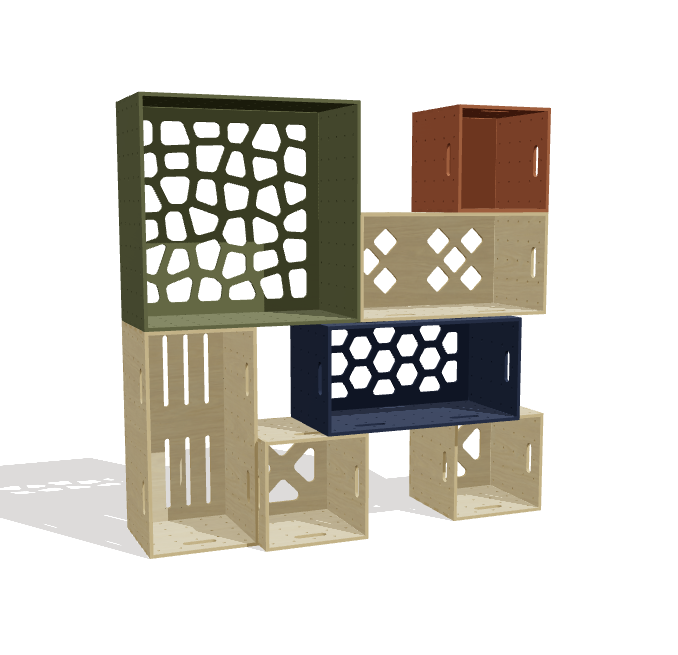
The System
Every module is an open-front box made of five panels of 12 mm Baltic birch. Each side is a whole number of 14.5" units, from 1x1 up to 2x3, and every module is one unit deep.
The 14.5" unit wasn't picked at random:
- The biggest module, 29" x 43.5", just fits inside SendCutSend's 30" x 44" maximum part size.
- A 4 x 4 grid of 14.5" cells uses 93% of a 5' x 5' sheet of Baltic birch, for anyone cutting the parts on their own CNC.
- The 13.5" interior fits LP records, 13" storage bins, and tall art books.
Every wall panel has a 10 mm hole every 2.9" (a fifth of a unit). The holes are placed on one shared grid, so wherever two modules touch, their holes line up, and they bolt together with barrel nuts. Modules can also be shifted by whole 2.9" steps and still bolt on. When you move house, unbolt the boxes, and a small module turned open side up becomes a crate.
All of the parts are flat 2D cuts with finger joints, so assembly needs only glue, ratchet straps, and a hex key for the bolts. No router or table saw.
The Editor
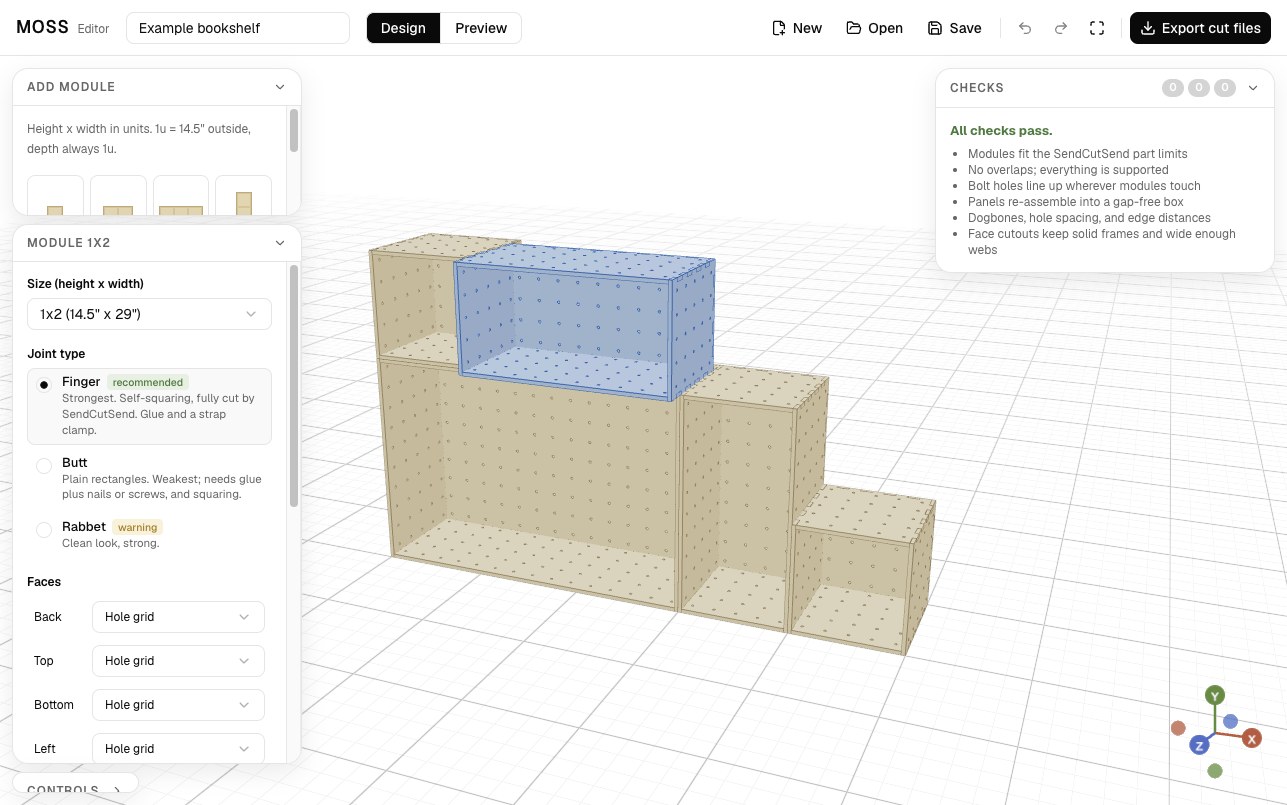
The editor runs entirely in the browser, with no account and nothing to install.
- Design mode is for building the layout: drag modules around a grid, pick a joint type and a face design for each panel (bolt grid, solid, handles, slots, or a structural lattice), and get live checks for overlapping boxes, floating or overhanging modules, and anything that breaks SendCutSend's manufacturing rules.
- Preview mode shows it built: real birch plywood with raw, matte, satin, or gloss finishes, painted modules, and true-to-scale books, records, and plants to check the fit.
- Export downloads a zip of DXF cut files and a parts manifest, ready to upload to SendCutSend.
Under the hood it's a Next.js app with the 3D scene in React Three Fiber. The geometry, validation, and DXF export live in a plain TypeScript package with no React or browser dependencies, so the same code also runs from a command line.
Try It
Head to basalt.design/moss for the full tour, or jump straight into the editor. The design notes explain the reasoning behind every dimension.